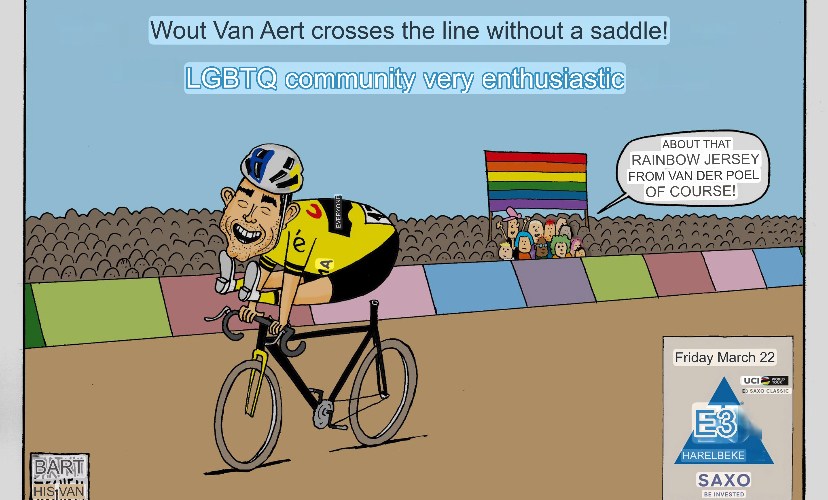
The polemic cartoon published by the E3 Saxo Classic has reopened the debate about homophobia in professional cycling. While numerous female cyclists have freely declared their sexual orientation, currently no male professional cyclist is openly gay or bisexual. In this article, we will present the experiences and views of different cycling protagonists on homophobia in the men’s peloton.
According to a recent study by the consultancy firm Ipsos in 30 countries around the world, 8% of men aged 16 to 74 identify themselves as homosexual, bisexual or pansexual. Among Generation Z, those born since 1997, the percentage is 14%. Statistically, each WorldTeam would have about 3 non-heterosexual cyclists. However, among the 910 cyclists registered in WorldTeams and ProTeams in 2024, there are exactly 0 cyclists who publicly declare themselves to be gay or bisexual.
Last year, I posted a tweet asking for people experiences to prepare this article. Former cyclist Nick Mckey (1999, USA) wanted to share his experience as a pro rider in 2018 in the United States.
I raced at a Conti level in the US and received as much vitriol from some of my teammates as I did the big pick up trucks on the road that harass us here. My detailed story on my team was my nickname was “the fat, gay, r*tard”, obviously “gay” not being said in a great context sandwiched in between those two other terms. It went unchecked and I’d say a good 1/3 of my teammates called me that more than my actual name. It ruined my mental state and was honestly one of the instances that lead to my exit from the racing world.
I was the 2nd youngest on the team and pretty defenseless as the team had all been racing rivals/friends for years and I was pretty anonymous on the scene up to joining this team, and even knowing I was in a bit more vulnerable position the DS did nothing. On top of the nickname there was a constant sprinkling of “cocksucker”, “f*g”, claims that I was the “gayest thing since Freddie Mercury”, jokes about being surprised about “not having AIDS” yet, questions about how many dicks I’d sucked since we’d last been together as a team. I’m not even part of the LGBTQ+ community beyond being an ally, I just had longer hair and I have a higher pitched voice.
Nick Mckey
During January 2024, I spent several days in the Comunitat Valenciana, in Spain, where most of the teams organise their training camps. For this article, I was able to observe a Tinder account of a heterosexual woman. In one afternoon, I could see at least 30 profiles of male professional cyclists, most of them with photos of their races and victories, proud to be cyclists.
However, looking at one account on Grindr (the leading gay dating app), there were no photos of cyclists, nor any mention about cycling in the bios. Instead, there were multiple profiles with no name or face pic. A Grindr user from Altea (Comunitat Valenciana) revealed to me that he had dated cyclists and footballers who train in the area in winter, although they are very discreet to avoid being discovered.
“There is not a favourable environment for a person to express their feelings freely”, says Luis Ángel Maté (1984, Spain), professional cyclist since 2008 and participant 6 times in the Tour de France. “There are still a lot of prejudices, people don’t realise that masculinity and sport don’t necessarily go hand in hand. These are messages that are transmitted from an early age”. In any case, according to the veteran Spanish cyclist, cycling has made progress in terms of inclusion. “I’m very pleased to see that every day that you go out on a bike there are a lot of women on bikes. I hope that, when the next generations are adults and mature, this will change”.
What would happen if a professional cyclist came out? According to Maté, “it would be super nice for our sport. It would be breaking a barrier, a very important step. I have no doubt that he would integrate perfectly”. Among amateur cyclists, two cases stand out: cyclocross specialist Justin Laevens (2001, Belgium) and road cyclist Clay Davies (1992, Great Britain). Both made the coming out in 2021. Laevens left cycling in 2022, without ever turning pro, while Davies continues to compete at a good level on the British national calendar.
In an interview with Cycling Weekly, Justin Laevens related his good experience after the coming out. “It went crazy on my Instagram. I’ve had only good reactions. No one hates me! Being gay is acceptable and normal for younger riders, whereas maybe less so for some older guys,” said Laevens. On the other hand, Clay Davies was more critical in an interview with The British Continental, from which we extract the main parts:
At the start line at the Tour Series, you sometimes see riders’ girlfriends lean over the fence and give their boyfriend a kiss for good luck. Can you imagine seeing that with a gay couple? A boyfriend giving a kiss to a male rider on the start line, and that being shown on the highlights on ITV? I don’t think we are there yet. I’ve had boyfriends come to watch me at a bike race, but they’ve sort of stayed in the corner, as it were.
You cannot force riders to come out but the UCI, top-level teams and British Cycling can do much more in laying the groundwork for all riders to be themselves and make acceptance the norm. I’m at the age where I don’t really give a monkeys. But I can see if you were an under-23, or a junior, younger and more sensitive, that it could be a strange environment, lacking support.
It requires an enormous amount of energy, mental energy, to be in the closet. To give you an example, when someone says, ‘Who are you seeing these days?’, you never say ‘she’ or ‘he’. It’s always ‘them’ or you try to change the subject. You’re constantly on your guard, waiting for the next awkward question to come through. It’s exhausting, absolutely exhausting. If you’re in the closet, and you don’t want people to know, you’re constantly worried. Worried about friends seeing you out with someone, or seeing that you’re on a dating app, or whatever. It’s just a constant drain on your energy.
Clay Davies
The emergence of teams and sponsors from Arab countries where homosexuality is forbidden is also a controversial issue. However, Joxean “Matxin” (1970, Spain), general manager of UAE Team Emirates, denies that it could be a problem. “This is a sports team. There would be no problem if someone came out as a homosexual in the team. We don’t have any internal rules about that and it has never been considered,” says Matxin. “In 30 years managing teams, I have not seen anyone rejected or pointed out because of homophobia. In cycling there is no such thing as a hater, people always support the cyclist, even in moments of maximum rivalry. If there were haters of certain cyclists, it would not be well received by the rest”, commented Matxin.
Patrick Lemieux (1987, USA), a cycling agent, also reflected on how coming out would affect a cyclist on a commercial level. “No matter your sexual orientation, you have to be successful athlete on the field of play. We’ve seen with the gay skier Gus Kenworthy, who was incredibly successful on his field of play, but he also was a face of that community and I think benefited heavily from it financially. So I do believe the commercial value of a cyclist could go up, but that has to be in tandem with their results as well”, explains Lemieux. “I would absolutely advise them to be forthcoming about that. It’s really important to be true to one’s ethos and whether that’s what they want to do around a certain race or what they want to do around their personal life”, the American agent concludes.
If you are a cyclist and you want to share your experience anonymously or not, you can write to banqueriraul@gmail.com or send a direct message en Twitter/X to raulbanqueri.
Recommended readings:
Why is the peloton hiding its true colours? – Cycling Weekly (2021)
Why coming out is still hard to do – The British Continental (2021)
Clay Davies interview: free spirit – The British Continental (2021)
Being gay in cycle sport: a junior rider’s experience – The British Continental (2021)
 Raúl Banqueri
I wonder if someone did come out, would the weight of being the “face of the gay community” add excessive pressure? More or less than the drain on energy Clay spoke about, from being in the closet?